
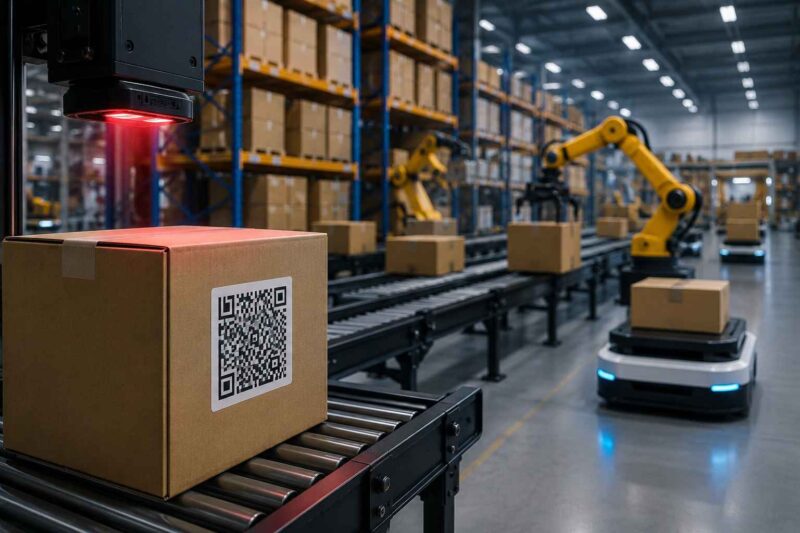
E-commerce warehouses are under constant pressure to receive inventory faster, maintain accurate stock records, and dispatch orders without adding unnecessary labor. Traditional one-dimensional barcodes still support many of those tasks.
Their limited data capacity can create extra scans, manual checks, and repeated database lookups as order volumes grow.
Amazon sellers that do not operate their own compliant preparation facility can use Dollan’s FBA prep services to combine receiving, inspection, labeling, packing, and 2D-enabled shipment preparation before inventory enters Amazon’s fulfillment network.
Such support can be useful when shipment volume has grown beyond what an in-house team can process accurately.
Two-dimensional barcodes give warehouse systems more information from a single scan. Automation then uses that information to direct inventory through receiving, storage, picking, packing, and shipping.
The result is not merely faster scanning. Each physical item becomes easier to identify and track throughout the warehouse.
Traditional barcode workflows can create delays
A standard one-dimensional barcode usually carries a product identifier. The scanner reads that number. Warehouse software then searches a database to retrieve the product description, unit size, storage location, and other records.
Such a process works well when a warehouse handles a limited range of products. Problems become more visible when the facility processes thousands of SKUs, multiple product variants, expiration dates, batches, and marketplace requirements.
A worker may need to scan one code for the product, read a printed date, confirm a lot number, and enter another value manually. Every additional step adds time. Manual entry also creates opportunities for reversed digits, incorrect dates, and inventory assigned to the wrong batch.
Damaged labels create another delay. A conventional barcode normally requires a clean horizontal scan path. A crease, tear, or poorly printed section can make the symbol unreadable. The unit may then need to be relabeled or moved to a separate inspection area.
What a 2D barcode adds to the process?
A 2D barcode stores information across two dimensions. Common formats include QR codes and GS1 DataMatrix symbols. They can carry more data than traditional linear barcodes and still occupy a relatively small area on a label.
According to current 2D barcode standards, a symbol can include a Global Trade Item Number alongside attributes such as a batch number, expiration date, or serial number. Error-correction features can also make some symbols readable after limited label damage.
Greater capacity does not mean that every available product record should be printed inside the barcode. A warehouse may encode the essential identifiers and use them to retrieve current records from its warehouse management system.
That approach keeps the label practical and allows information to be updated in the central database.
The difference becomes important in high-volume operations. One scan can identify the item and provide the data needed to decide where it should go next. Warehouse software no longer depends on a worker reading several fields from the package.
Receiving becomes faster and easier to verify
Receiving is one of the first places where 2D barcodes can remove a bottleneck. Incoming cartons must be matched with purchase orders, shipment plans, or advance shipping notices. Staff must also record quantities and identify damaged or unexpected inventory.
A carton-level 2D barcode can connect the package with its expected contents. Once scanned, the warehouse management system can display the supplier, shipment reference, included SKUs, expected quantities, and designated receiving procedure.
The employee still needs to inspect the shipment. Automation reduces the amount of information that must be entered manually. Discrepancies can be recorded immediately. Accepted stock can move to the next stage without waiting for paper documents to be compared with a separate spreadsheet.
Amazon FBA workflows can also use 2D carton information to associate box contents with an inbound shipment. Accurate preparation before dispatch gives the receiving facility clearer data about what should be inside each carton.
Poor labeling or incorrect shipment data will still cause delays, so barcode technology must be supported by proper quality control.

Automated storage depends on accurate identification
Automated storage systems cannot work reliably unless every unit, carton, or tote has a clear identity. A scanner records the item at receiving. Warehouse software then assigns a storage location according to product dimensions, demand, handling requirements, and available capacity.
Conveyors and automated sorters can read the code as the item moves through the facility. The control system sends it toward the correct storage zone.
Autonomous mobile robots can transport totes between receiving stations and shelving areas. Automated storage and retrieval systems can place goods into assigned positions without relying on a worker to remember the location.
Every movement creates a digital record. Inventory does not appear in stock simply because a purchase order says that it arrived. The system records the actual scan at the receiving station and again when the item reaches storage.
Real-time location records reduce the difference between physical inventory and the quantity shown online. Accurate stock data is critical for e-commerce businesses because an incorrect count can lead to overselling, canceled orders, and delayed refunds.
Picking systems can choose a faster route
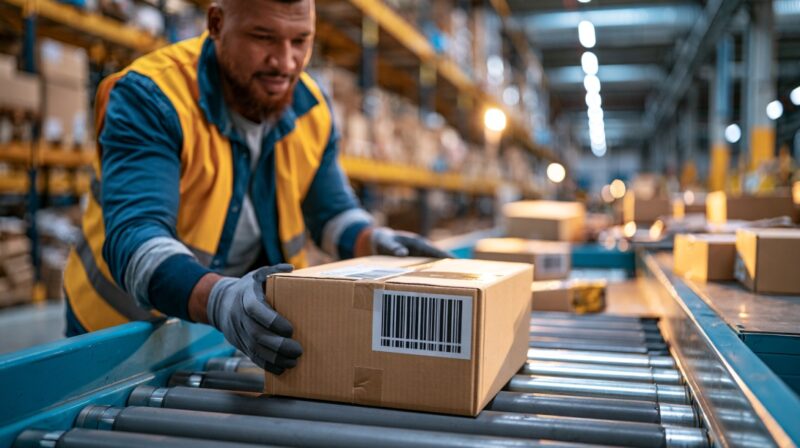
Order picking often consumes more warehouse labor than any other fulfillment activity. Employees may walk long distances between shelves. Poor location data increases that travel time and causes unnecessary searches.
A warehouse management system can group orders and calculate an efficient picking sequence. The system knows the location of each SKU because its movement was recorded during receiving and putaway.
Mobile scanners, pick-to-light systems, voice instructions, or warehouse robots can then guide the picker through the assigned route.
The 2D barcode provides a final identity check. A scan confirms that the employee selected the correct product, batch, size, or color. The system can immediately reject an item that does not match the order.
Such verification is particularly useful for products with similar packaging. A warehouse may hold several versions of the same device, cosmetic product, garment, or replacement part. Visual inspection alone may not reveal a small difference in size, model, or formulation.
Packing stations receive the correct instructions automatically
Packing requirements vary by product and sales channel. Fragile goods may need protective wrapping. Apparel may require a sealed bag. Multipacks must remain together. Marketplace shipments can require specific labels and carton information.
When the picked item reaches a packing station, its barcode can call up the correct instructions. The screen can show the required box, protective material, documentation, and carrier label. Automated equipment may select or form an appropriately sized carton.
Scales and dimensioning systems can compare the completed package with expected values. A large difference in weight may indicate a missing or incorrect item. The package can be diverted for inspection before it reaches the carrier.
Automated validation protects speed without removing quality control. Fast packing is valuable only when the correct order reaches the customer in acceptable condition.
Sorting and carrier handoff require fewer manual decisions
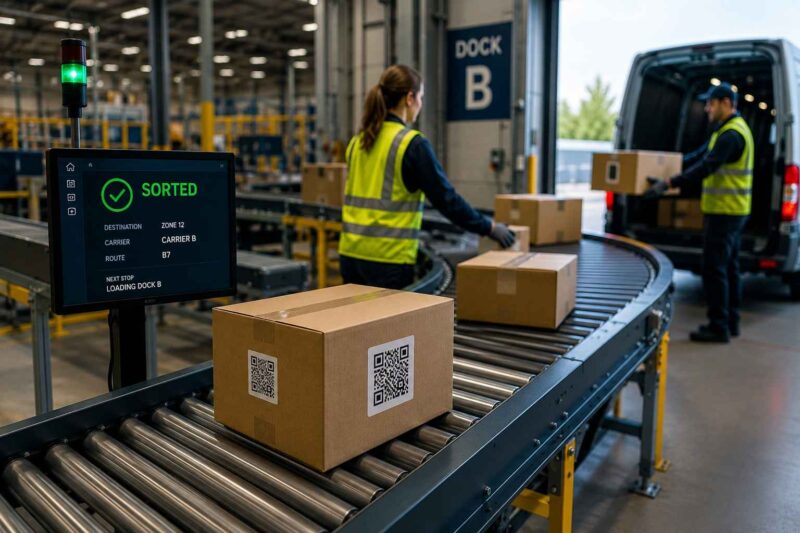
After packing, orders must be separated by carrier, service level, destination, and collection time. Manual sorting becomes difficult during seasonal peaks. Employees must process a larger number of parcels without missing carrier cutoffs.
Automated sortation equipment reads each package and sends it to the correct lane. The shipping system can confirm that the order was packed, labeled, and transferred to the designated carrier area. Tracking information can then be returned to the e-commerce platform.
Connections between warehouse and delivery systems are also important. A well-designed courier management system can use order and parcel data to coordinate dispatch, carrier selection, tracking, and delivery updates after the package leaves the warehouse.
Faster physical movement does not help if software platforms exchange incomplete or delayed information. Barcode scans, warehouse records, shipping systems, and customer notifications must refer to the same order.
Returns can be processed with better product data
Returns are harder to automate than outbound orders because the condition of each product must be assessed. A returned item may be unopened, damaged, incomplete, or different from the product originally shipped.
A 2D barcode can give the returns team access to the product identifier, serial number, batch, order record, and handling instructions. The system can compare the returned unit with the original transaction. Serial-level identification is valuable for electronics, tools, luxury products, and other goods at risk of substitution.
Once inspected, the item can be sent to restocking, refurbishment, liquidation, or disposal. Recording that decision immediately prevents damaged goods from being returned to available inventory.
Traceability improves recalls and expiration control
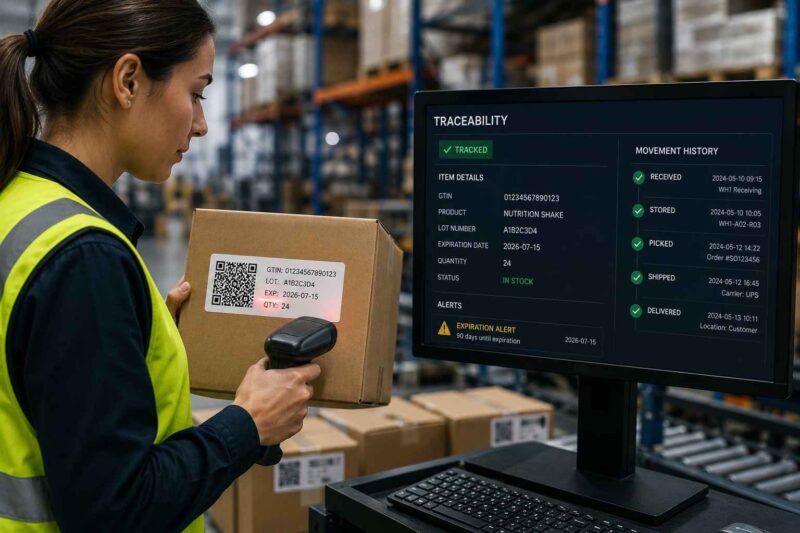
Product recalls can become unnecessarily broad when a warehouse cannot identify the affected batch. Staff may need to isolate every unit of a product because the system records only its general SKU.
A properly configured 2D barcode can include batch, lot, serial, or expiration information. Warehouse software can use that data to locate the relevant stock. Orders containing affected units can also be identified more accurately.
Expiration data supports better stock rotation. The warehouse management system can prioritize units with earlier dates instead of shipping whichever carton is easiest to reach. Such control reduces waste and helps prevent expired inventory from reaching customers.
Research published by GS1 US found that 2D barcode workflows may substantially reduce warehouse costs linked to shipment errors, rescanning, and relabeling. The underlying study covered 400 organizations in retail, logistics, manufacturing, and healthcare. Results will differ by facility, but the identified cost drivers are familiar to most large warehouses.
Sunrise 2027 is accelerating adoption
Retailers and manufacturers are preparing for a wider transition to 2D barcodes. GS1’s Sunrise 2027 initiative sets a target for retail point-of-sale systems to become capable of processing approved 2D symbols by the end of 2027.
The date is not a universal deadline that automatically makes every UPC unusable. Companies must evaluate the requirements of their retailers, marketplaces, suppliers, and warehouse systems. Many businesses will operate with both one-dimensional and two-dimensional barcodes during the transition.
Preparation should begin before new symbols appear across the entire product range. Existing scanners may be able to read linear codes but not every required 2D format. Software must also understand the encoded data and separate the GTIN, lot number, expiration date, and other fields correctly.
GS1 has published detailed implementation guidance for 2D barcodes. The guidance covers common application identifiers, barcode placement, data formats, testing, and retail use cases.
Warehouse automation still depends on reliable infrastructure
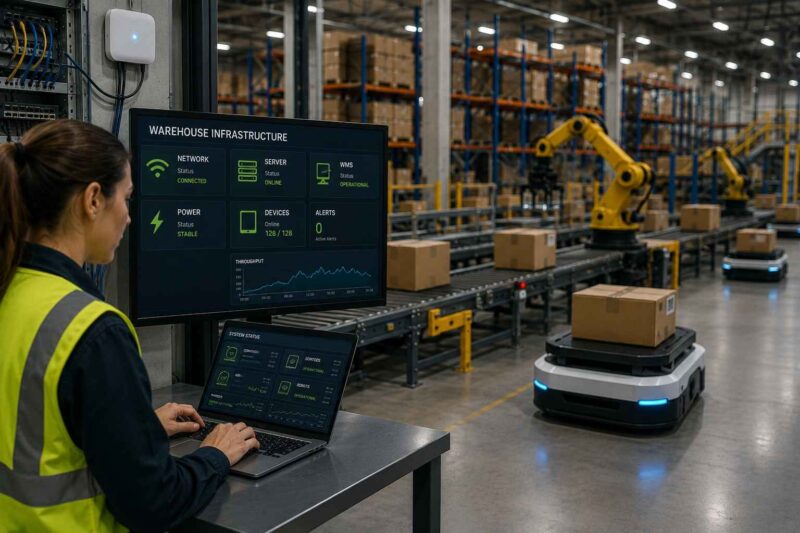
Automated equipment creates a continuous flow of operational data. Scanners, conveyor controls, mobile devices, robots, warehouse management software, and shipping platforms must remain connected during working hours.
A network interruption can stop receiving or prevent the system from confirming picks. Slow database responses can create queues at packing stations. Poor backup procedures can leave staff without accurate inventory records after a system failure.
Warehouses therefore need dependable computing, network, storage, and backup capacity. The same planning principles used for modern business data infrastructure apply to fulfillment operations. Capacity must support peak order periods, system integrations, security controls, and recovery procedures.
Speed comes from connecting every stage
A 2D barcode does not move a carton or pick an order on its own. Its value comes from giving warehouse systems a reliable identity for the item in front of them. Automation can then act on that identity without waiting for repeated manual checks.
Receiving becomes faster. Storage locations remain current. Pickers receive better instructions. Packing stations apply the correct rules. Sorters send parcels to the right carrier. Returns and recalls can be handled with more precise product data.
E-commerce companies that connect standardized identification with reliable warehouse automation gain more than faster scans. They create a supply chain in which inventory can move quickly without becoming harder to trace or control.