The rise of AI-driven video generation is reshaping modern journalism and content production workflows. Traditional newsroom setups are no longer sufficient for the speed and scale required by digital platforms.
AI news video generators now allow users to convert scripts, URLs, or prompts into fully produced broadcast-style videos featuring AI anchors, newsroom environments, captions, and automated editing systems. Below are five leading tools redefining this space.
1. Pollo AI
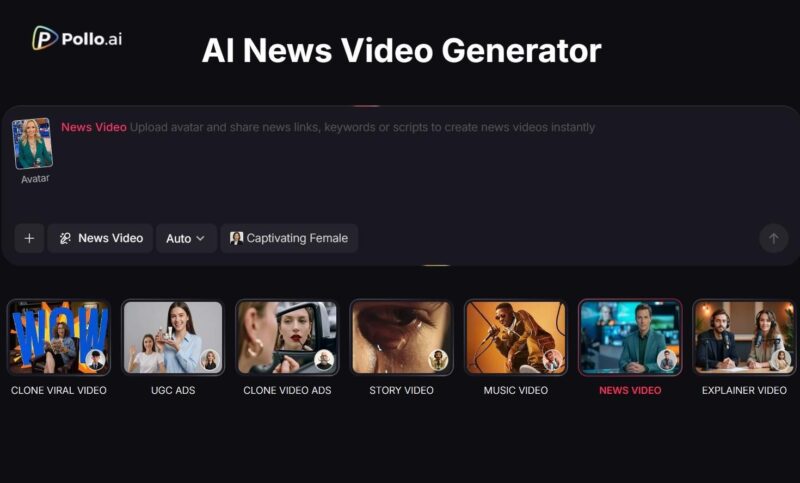
Pollo AI news video generator is designed to transform scripts, news article URLs, keywords, or even avatars into complete broadcast-quality news videos within minutes. On its interface, users can switch between multiple creation modes such as News Video, UGC Ads, Clone Video Ads, Story Video, Music Video, and Explainer Video, making it a unified creative hub rather than a single-purpose editor.
Within the News Video Generator, users can upload an avatar or select professional AI news presenters, input a script or article link, and instantly generate a structured news broadcast. The system automatically builds a newsroom-style production environment, pairing avatars with dynamic studio backgrounds, adding auto-generated captions, and integrating studio-style background music. It also supports multi-language reporting, allowing the same news content to be delivered globally without additional translation workflows.
From a product positioning perspective, Pollo AI is designed as a scalable AI media production engine, bridging entertainment content creation and professional broadcast-style journalism through automation, avatar realism, and multi-format generation capabilities.
Why Recommended
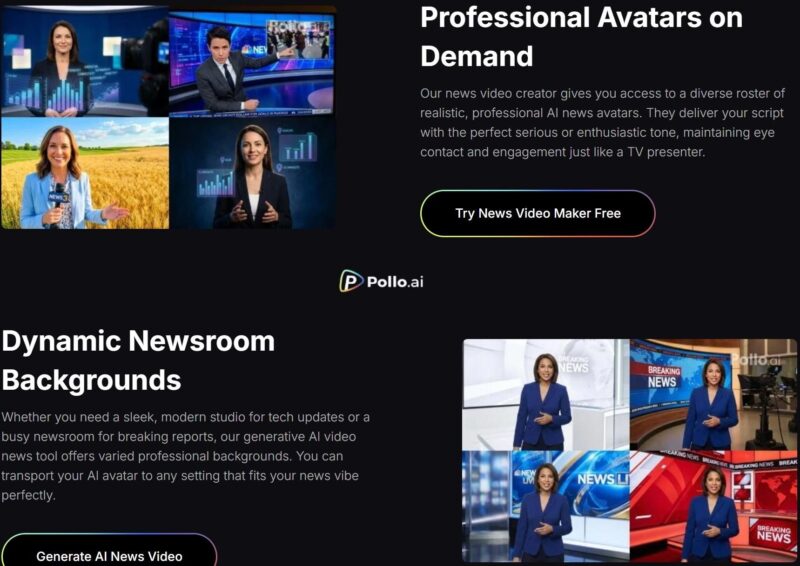
Pollo AI is recommended because it offers a highly streamlined, end-to-end automation workflow that significantly reduces production complexity while maintaining broadcast-level output quality, making it equally powerful for serious news production and lightweight creative formats like a video meme maker. Its interface is intuitive, allowing users to move from script or URL input directly to a finished video without manual editing, which makes it highly suitable for beginners and non-technical creators.
The system demonstrates strong instruction understanding, accurately interpreting scripts to generate appropriate scene structures, avatar delivery tones, and newsroom visual styles. In addition, its multi-mode ecosystem makes it highly versatile, supporting not only news production but also advertising, storytelling, and social media content creation. This makes it especially valuable for creators working across TikTok, Instagram Reels, YouTube Shorts, and marketing campaigns where speed, consistency, and scalable output are essential.
My Tip
Use news URLs instead of raw scripts to get more structured and contextually accurate video outputs.
2. HeyGen
HeyGen is an AI video generation platform focused on high-fidelity digital humans and avatar-based communication, with strong capabilities in news-style video production. Its interface centers around selecting or creating AI avatars, inputting scripts, and generating videos where virtual presenters deliver content with highly realistic facial expressions, lip-sync accuracy, and natural voice cadence.
The platform supports instant avatar creation from real human recordings, enabling journalists or spokespersons to create digital twins that can continuously deliver updates. It also includes multilingual translation features that preserve voice identity while adapting speech to different languages. Additionally, HeyGen provides API integrations for automated content pipelines, making it suitable for large-scale media organizations that need continuous news output.
Its product positioning is centered on realism, communication fidelity, and scalable avatar-driven broadcasting, making it particularly strong in professional news and corporate communication environments.
Why Recommended
HeyGen is recommended for its exceptional avatar realism and speech synchronization accuracy, which makes digital presenters feel highly credible and human-like. It is also highly efficient for multilingual content production, allowing news organizations to rapidly localize content without additional recording sessions.
The platform is easy to operate and integrates well into automated workflows through APIs, making it ideal for fast-paced environments where news must be generated and distributed continuously. It is especially suitable for global news teams, digital media outlets, and corporate communication departments that require high trust, realism, and linguistic scalability.
My Tip
Use a short real-person recording when creating avatars to significantly improve emotional realism and delivery quality.
3. Synthesia
Synthesia is a structured AI video platform designed primarily for corporate communication and professional newsroom-style content creation, offering a large library of virtual studio environments, AI avatars, and multi-scene editing capabilities. Its interface allows users to build videos using predefined newsroom templates, complete with virtual desks, professional lighting setups, multiple camera angles, and gesture-enabled avatars capable of emphasizing speech through controlled movements like nodding or hand gestures.
Users can create multi-scene productions where different avatars and environments represent different segments of a news broadcast. It also includes collaboration tools that allow teams to co-edit scripts and videos, as well as built-in content moderation features that ensure responsible AI usage. Synthesia’s product positioning is centered on structured, safe, and scalable corporate-grade video production, making it ideal for internal communications and formal news presentations.
Why Recommended
Synthesia is recommended because it provides extremely stable, predictable, and structured video outputs, making it ideal for organizations that require consistency across large volumes of content. Its multi-scene editing system allows users to simulate full news programs with clear narrative segmentation, which is particularly useful for corporate storytelling and training-style news content.
The platform is also highly collaborative, enabling teams to work together efficiently on scripts and visual design. It is best suited for enterprises and institutions that prioritize clarity, professionalism, and workflow stability over creative experimentation.
My Tip
Use multi-scene templates to simulate real newsroom segmentation for more professional storytelling flow.
4. Runway

Runway is a high-end generative video platform designed for cinematic storytelling and visual journalism, enabling users to create realistic or stylized video sequences using advanced AI models capable of simulating physics, lighting, and camera motion. Unlike avatar-focused tools, Runway emphasizes environmental generation and scene construction, allowing users to produce immersive visuals for investigative journalism, documentaries, or abstract news topics.
Its features include motion control tools, advanced camera path manipulation, and the ability to transform static images into dynamic video sequences. This makes it particularly useful for illustrating complex or non-filmable subjects such as data systems, climate events, or geopolitical scenarios.
From a positioning perspective, Runway serves as a creative visual engine for narrative-driven journalism, pushing news content beyond traditional talking-head formats into cinematic storytelling experiences.
Why Recommended
Runway is recommended because it provides unmatched creative flexibility and cinematic control, allowing journalists to visually represent stories that would otherwise be impossible or too costly to film. It is particularly effective for long-form storytelling where visual immersion is as important as factual reporting.
The platform also offers advanced control over motion and composition, making it suitable for creators with some visual production experience. It is best used in investigative journalism, documentary production, and experimental media formats where storytelling depth and visual impact are critical.
My Tip
Use Runway primarily for B-roll and conceptual visuals rather than direct news narration.
5. InVideo
InVideo is an AI-powered video creation platform optimized for rapid social media content production, allowing users to convert text prompts, scripts, or URLs into short-form news videos tailored for platforms like TikTok, Instagram Reels, and YouTube Shorts. Its interface is designed for speed, automatically generating scripts, selecting stock footage from a large media library, adding voiceovers, and embedding subtitles.
Users can quickly edit outputs using drag-and-drop tools to replace clips or adjust pacing. The platform is particularly strong at summarizing news articles into short video formats, making it highly effective for real-time trending content distribution. Its product positioning focuses on speed, accessibility, and high-volume short-form publishing, making it ideal for digital-first media creators.
Why Recommended
InVideo is recommended because it offers extremely fast content turnaround with minimal learning curve, making it highly suitable for creators who need to publish multiple updates per day. Its automatic media matching system reduces the need for manual editing, while its simple interface ensures accessibility even for non-professional editors. It is particularly effective in viral content environments where speed and trend responsiveness matter more than deep cinematic control. This makes it ideal for social media news pages, marketing teams, and creators focusing on high-frequency content distribution.
My Tip
Always manually review AI-selected stock clips to ensure narrative accuracy and visual relevance.
Conclusion
AI news video generators are fundamentally transforming how news content is created, distributed, and consumed. From Pollo AI’s all-in-one production ecosystem to Runway’s cinematic storytelling engine, each tool serves a different layer of modern digital journalism. Together, they enable creators, media teams, and organizations to build scalable, automated, and visually compelling news workflows without relying on traditional studio infrastructure.