
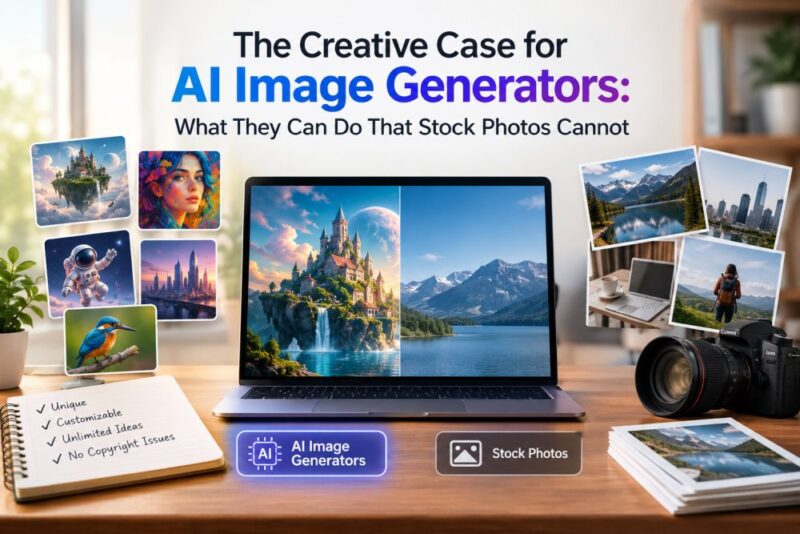
Stock photography has a familiar problem. You search for something specific – a small business owner in a realistic office setting, a diverse team collaborating in a way that does not look staged, a product shown in a context that does not exist yet – and what you find is a grid of images that look like they were taken at the same session in the same office building in 2014. Technically competent. Visually generic. Recognisable to every reader who has encountered them elsewhere.
The alternative has historically been commissioning original photography or illustration – expensive, time-consuming, and logistically complex for anything involving people, locations, or products that exist only as concepts. For most creators working under time and budget constraints, the stock library remained the default despite its limitations.
AI image generators have introduced a third option that is genuinely different from both – not a replacement for professional photography in contexts where authenticity and precision are paramount, but a practical creative tool for the wide range of situations where what matters is a compelling, specific, custom visual that stock cannot provide and commissioned work cannot justify.
What Makes AI Image Generation Different From What Came Before

The fundamental difference between an AI image generator and a stock search is the direction of causality. In a stock search, you find images that already exist and hope one of them fits your need. With an AI generator, you describe the image you need and the system creates something that did not exist before.
This reversal has practical consequences that are easy to understate. It means that the specificity of what you can create is limited by your ability to describe it, not by what happens to have been photographed, illustrated, or digitally rendered by someone else. The specific scene, mood, palette, compositional arrangement, and stylistic register you have in your mind can be pursued directly rather than approximated from available inventory.
A creator working on a social media campaign for a tech product can describe the exact visual context they want – a particular combination of lighting, setting, subject demographic, colour temperature, and compositional style – and generate options that pursue that specific vision. The same creator searching a stock library is choosing between what exists, which is a fundamentally different creative experience.
The combination of text description and generative capability also means that visual styles that would be prohibitively expensive to produce through traditional means become accessible. A watercolour illustration of a specific scene, a photograph-style render of a product that does not yet exist in physical form, an aerial perspective of a location shown in a particular season and lighting condition – these are within the practical reach of anyone who can describe them clearly.
How Prompt Quality Shapes Output Quality

The quality of results from an AI image generator depends significantly on how well the prompt communicates the intended output. This is a learnable skill rather than a technical one, and it develops quickly with practice.
Several principles consistently produce better results.
Describe the subject before the setting. Most generators weight the beginning of a prompt more heavily. Establishing what the primary subject is before describing where it is or how it looks helps ensure the central element of the image is handled correctly.
Reference visual qualities through established categories rather than only through adjectives. Telling a generator to produce “a warm, inviting image” gives it less to work with than describing “warm late afternoon light, golden hour, shallow depth of field, soft bokeh background.” The second description invokes a specific photographic register that the model has encountered many times in training.
Include negative constraints where the tool supports them. Naming qualities to exclude – overexposed, cluttered, text, watermark, unrealistic proportions – reduces the likelihood of unwanted elements appearing even when they have not been described positively.
Generate multiple variations and select. The same prompt produces different results each time due to the inherent variation in the generation process. Producing four to eight options from a single prompt and selecting the strongest one is more reliable than treating the first output as definitive.
Iterate on what is close rather than restarting. When an image is mostly right but wrong in specific ways, adjusting the prompt to address those specific elements and regenerating is more efficient than starting over with a completely different approach.
The Workflow Contexts Where AI Generation Adds the Most Value
Understanding where AI image generation is most practically useful helps allocate the tool appropriately rather than applying it everywhere indiscriminately.
Concept visualisation before production commitment. When a team is exploring visual directions for a campaign, a product, or a content series, AI generation allows multiple concepts to be visualised quickly before any resource commitment is made. The ability to see three different visual directions as actual images rather than verbal descriptions changes how decisions get made and often surfaces the right choice earlier in the process.
Custom imagery where stock does not fit. Situations where the specific combination of subject, context, aesthetic, and composition required is simply not available in stock libraries — which describes a large proportion of real creative briefs — become tractable with AI generation. The image can be built to specification rather than approximated from inventory.
High-volume social content. For creators and teams producing large volumes of visual content for social platforms, AI generation allows custom imagery at a scale and cost that commissioned work cannot match. The ability to produce ten variations of a concept in the time it would previously have taken to find one adequate stock image changes what is possible within normal content production schedules.
Thumbnail and cover art exploration. The visual performance of content often depends significantly on the thumbnail or cover image. AI generation allows multiple options to be created and tested without the cost and time of individual commissioning, enabling a more data-driven approach to visual optimisation.
Placeholder assets in development. Design and development workflows that need placeholder images to stand in for final assets benefit from AI generation’s ability to produce contextually appropriate placeholders quickly — images that communicate the intended visual direction without requiring final production assets to be ready.
Where Human Judgment Remains Essential

The most effective creative use of AI image generators involves human judgment at several critical points rather than treating the technology as a self-sufficient pipeline.
Prompt construction is itself a creative act. Deciding what to describe, how to frame the subject, what stylistic qualities to invoke, and what to exclude requires creative thinking that the generator cannot supply. The quality of creative direction provided through the prompt directly shapes what is possible in the output.
Selection from generated variations requires aesthetic judgment, contextual knowledge, and understanding of the specific creative objectives. Identifying which generated option best serves the intended purpose — and recognising when none of the options do — is a distinctly human contribution.
Post-generation editing is often necessary to bring AI-generated images to final-use quality. Colour correction, compositing with other elements, correction of specific artefacts, and integration with text or branding elements typically require additional processing after generation.
Contextual appropriateness — whether a generated image is culturally appropriate, emotionally resonant for the intended audience, and aligned with brand or editorial standards — is a judgment that requires human understanding of the specific context in ways that the generator cannot independently assess.
The Limitations Worth Keeping in Mind

Accurate evaluation of AI image generation requires acknowledging its genuine limitations alongside its capabilities.
Specific text within images remains unreliable. When a generated image needs to include readable text — a sign, a label, a headline — the output requires careful checking and often manual correction. The architecture of diffusion models was not designed with typographic precision in mind.
Precise spatial relationships are often approximated rather than accurately rendered. When a prompt describes a specific geometric arrangement, a particular count of objects, or an exact compositional relationship between elements, the output tends to pursue an approximation rather than a literal realisation.
Photographic identity fidelity — producing images where a specific real person appears accurately — is both technically unreliable and ethically constrained. Responsible generators implement restrictions around generating images of identifiable individuals, and outputs that bypass these restrictions carry significant legal and reputational risk. For broader guidance on intellectual property issues around generative AI, see the World Intellectual Property Organization’s guidance on generative AI and intellectual property.
Consistency across multiple generations requires deliberate effort. Producing a series of images that share a coherent visual identity — the same character, the same environment, the same style register — needs careful prompt management and often additional workflow steps beyond single-generation use.
Frequently Asked Questions
Do AI image generators require design skills to use effectively?
Can AI-generated images be used commercially?
How do AI image generators handle complex scenes with multiple elements?
Are there ethical considerations in using AI image generation?
Yes. The training data question — whether models trained on copyrighted images create liability for their outputs — is being resolved differently across jurisdictions. The output ownership question is also evolving legally. Creators using AI-generated images in professional contexts benefit from monitoring legal developments in their relevant jurisdiction and understanding the specific terms of the platforms they use. Standards such as C2PA Content Credentials are also being developed to make it easier to identify how digital media was created or modified.
The Bottom Line
AI image generators represent a genuinely new capability in the visual content toolkit — not a replacement for photography or illustration where those are the right tools for the job, but a practical option for the wide range of situations where the specificity of a custom image is needed and the resources for commissioned production are not available.
The creative value comes from the combination: human creative direction through prompt construction, AI generation capability, human selection and editorial judgment, and human post-processing where needed. Neither the human nor the AI component is self-sufficient. Together, they expand what is practically possible for any creator working with visual content in 2026.